HomeThe name
Why Is It Called Cabbagetown? The Name, Its Origin and Its Long History
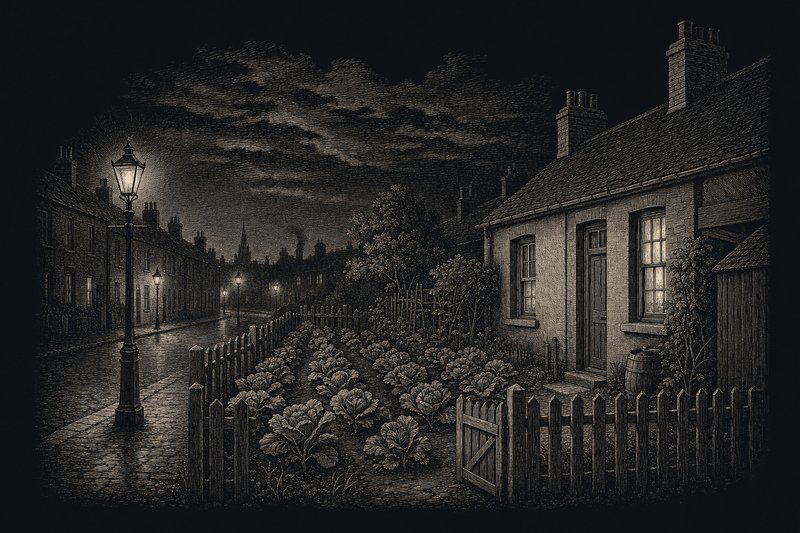
Why is Cabbagetown called Cabbagetown? Everyone in Toronto knows the short version: poor Irish families, front yards, cabbages. The longer version has a moving map, a famous novel and a name that no surveyor ever drew.
From park lot to heritage district
The name, year by year
- 1795
A park lot east of Parliament
Lieutenant Governor John Graves Simcoe receives a Crown grant of two hundred acres for his son Francis, between Parliament Street and the Don River. The land later becomes the northern part of Cabbagetown.
- 1840s
Famine emigrants arrive
Irish families escaping the famine settle east of Parliament Street. The front-yard vegetable plots of this period are where the nickname is usually traced.
- 1850
The Toronto Necropolis opens
A non-denominational cemetery is laid out on the rim of the Don Valley at the end of Winchester Street.
- 1856
Toronto General Hospital on Gerrard
A turreted hospital building rises on the north side of Gerrard Street East. It stands until 1922; Gifford Street and Nasmith Avenue are laid out on its grounds in the 1920s.
- 1870s–1880s
The building boom
Most of the row houses, cottages and bay-and-gable houses that line the streets today go up in these two decades.
- Early 1900s
Two names, two areas
The name Cabbagetown belongs to the streets south of Gerrard. The streets to the north, where most of the surviving houses stand, are still called Don Vale.
- Late 1940s
Regent Park replaces the original streets
Much of the original Cabbagetown south of Gerrard is cleared for the Regent Park housing project. The first families move into Regent Park North in 1949.
- 1950
The novel
Hugh Garner publishes Cabbagetown, set among the neighbourhood’s poor during the Depression. A fuller edition follows in 1968.
- 1970s
The houses are restored
Young professionals buy and repair the Victorian houses north of Gerrard. Today the name Cabbagetown refers to these streets.
- 1982
The festival
The local business improvement area forms, first of all to run the Cabbagetown Festival in September.
- 1987
A preservation association
Residents found the Cabbagetown Preservation Association to protect the look of the streets.
- 2002
The first heritage district
City Council designates the Cabbagetown-Metcalfe Area Heritage Conservation District.
- 2024
The last residential district
Council adopts the Cabbagetown Southwest Heritage Conservation District Plan in February; the Ontario Land Tribunal approves it in December.
Why is Cabbagetown called Cabbagetown? Ask on Parliament Street and the answer comes back in one breath: the Irish grew cabbages in their front yards. It is a good answer, and it is broadly the right one. It leaves out the more interesting part, which is that the streets now wearing the name are not the streets that first earned it.
This page takes the question of why is it called Cabbagetown in three passes. First the story everyone tells, then the map the name has travelled across, then the novel that fixed it in the Canadian imagination. The timeline above runs underneath all three.
Why is it called Cabbagetown? The short answer
The explanation given by the Cabbagetown Preservation Association, and repeated by the local business association, starts in the 1840s. Irish families escaping the famine settled in the cheap land east of Parliament Street. They were poor, the lots were small, and the front yards went under vegetables. Cabbages were the crop people remembered, and the district took its name from them.
That is the whole of the Cabbagetown name origin as it is usually told, and nothing in the record argues with it. There are variations. The Canadian Encyclopedia describes working-class settlers from Ireland and England arriving mainly between 1860 and 1880, and some tellings add Macedonian families to the Irish. None of these versions changes the essential picture of a crowded, poor district growing its own food wherever there was soil.
So if the question is simply why is it called Cabbagetown, the answer is poverty, gardens and a nickname that stuck. The rest of the story explains where it stuck.
The origin of the name, and the streets that first carried it
Here is the part the one-breath answer skips. In the nineteenth century, and well into the twentieth, the name Cabbagetown did not belong to the tree-lined Victorian streets that now appear on postcards. It belonged to the poorer blocks further south.
A City of Toronto heritage plan written in 2007 sets this out plainly. The name was originally applied to the area north of Queen Street between Parliament Street and the Don River, and until the Second World War it was not considered to reach anywhere north of Gerrard Street East. The streets north of Gerrard, where most of today’s surviving houses stand, were known as Don Vale.
Then the map changed. From the late 1940s, much of the original Cabbagetown south of Gerrard was demolished to build Regent Park, a large public housing project. The houses went, but the name did not. It gradually moved north and settled on the Victorian streets around Winchester, Sumach, Metcalfe and Carlton. If you want to see the line where that happened, stand at Parliament and Gerrard and look both ways. The page on where Cabbagetown is maps what the name covers now.
This is why the Cabbagetown name origin is really two stories. One is about cabbages in the 1840s. The other is about a name that survived the demolition of the place it described.
Don Vale, the name that came first on the northern streets
It is worth pausing on the older name, because most visitors have never heard it. Don Vale described the land north of Gerrard Street that sloped down to the valley of the Don River. In the 1840s and 1850s it was laid out and settled, and a topographical plan drawn by James Kane in 1842 shows the ground already cleared of its original trees, with a rough outline of proposed streets and no buildings yet. The first house recorded in what is now the Northwest heritage district went up in 1850.
For decades the two names sat side by side, one for the poorer blocks south of Gerrard and one for the streets to the north. That overlap is one reason accounts of where Cabbagetown began differ so much. Only after the southern blocks were demolished did the northern name fade and the vegetable take over the map.
A name nobody surveyed
The same heritage plan quotes the local historian George Rust-D’Eye, author of Cabbagetown Remembered, on a point worth repeating: Cabbagetown has never been a legally defined place name, and it was never surveyed. The question of where it is, or was, has been argued over even by people who lived there at the same time.
That sounds like a technicality until you notice how much depends on it. Real estate listings stretch the name in every direction. The City’s statistical neighbourhood is called Cabbagetown-South St. James Town and includes high-rise blocks that no Victorian ever saw. Only the heritage conservation districts, five of them, each with “Cabbagetown” in the title, give the name something like a legal edge.
A small aside for anyone who likes maps: the grid the neighbourhood sits on is older than any of this. The streets carry on the town survey of 1793, so they cross at right angles, and the one real curve is where Spruce Street bends into River Street.
History in print: Hugh Garner’s Cabbagetown
A nickname becomes permanent when somebody writes a book with it on the cover. Hugh Garner did that in 1950.
Garner was born in Batley, Yorkshire, in 1913 and came to Toronto with his family in 1919. His novel Cabbagetown followed young people in the district through the Depression, when it was, in the novel’s framing and in many readers’ minds, the most famous slum in Canada. The first edition was abridged; the full text appeared in 1968. Garner himself described the area as “the largest Anglo-Saxon slum in North America”, a line the Cabbagetown Preservation Association still quotes.
He came back to the neighbourhood in The Intruders, published in 1976, which looks at the same streets as middle-class buyers moved in and began restoring the houses. Read together, the two books cover almost exactly the arc this page describes: the name as a label for poverty, and then the same name on a street people were paying to live on. A housing co-operative in Cabbagetown now carries Garner’s name.
From slum to heritage district: a short history of the name’s reputation
The turn came from the 1960s onward. A new generation bought the run-down houses north of Gerrard and began restoring them, carved trim and all, as the house-style guide describes. By the 1970s young professionals were buying throughout the district, and the old nickname had become a selling point.
Residents then organized to keep what they had restored. The Cabbagetown Preservation Association was founded in 1987. In 2002 City Council designated the first heritage conservation district, Cabbagetown-Metcalfe; Cabbagetown North followed in 2004, Cabbagetown South in 2005 and Cabbagetown Northwest later in the decade. The last residential piece, Cabbagetown Southwest, was approved in 2024. Every one of them carries the vegetable in its name.
It is hard to think of another city neighbourhood whose official planning documents are named after a joke about poverty. That is one reason people who have just walked through it keep asking the same thing: why is Cabbagetown called Cabbagetown?
The name in official use
For a nickname that began as a jibe, “Cabbagetown” now appears in a surprising number of official places. Each of the City of Toronto’s five heritage conservation districts in the area carries it: Cabbagetown-Metcalfe, Cabbagetown North, Cabbagetown South, Cabbagetown Northwest and Cabbagetown Southwest. The heritage plan for the Northwest district even explains why the name belongs in its title, arguing that the blocks west of Parliament share the same period of building, the same grid and the same unbroken rows of narrow houses as the districts to the east.
The merchants along Parliament Street use it as well. Their business improvement area formed in 1982, first of all to run the Cabbagetown Festival, and it is the association that sells the neighbourhood flag. The City’s statistical neighbourhood, meanwhile, is called Cabbagetown-South St. James Town, which stretches the name over towers that went up long after the cabbages were gone.
What none of these uses does is fix the name to a line on the ground. The heritage districts protect specific properties; the business area covers specific streets; the statistical unit exists for counting people. The Cabbagetown name origin lies in none of them, and the neighbourhood people mean when they say the word is still a matter of habit, not of law.
What the name looks like today
Walk the streets now and the cabbage is everywhere except in the gardens. It is on the Cabbagetown flag, a green cabbage on a white centre, and in the name of the festival that fills the streets each September. The front yards are as small as ever, and they are now far more likely to hold flower beds than vegetables.
Anyone still asking why is it called Cabbagetown should walk it. The heritage walk starts at the western edge of the neighbourhood and ends at the Necropolis and St. James Cemetery, both of which were already there when the first cabbages went into the ground. The fuller history of Cabbagetown picks up the threads this page leaves loose, from the Toronto General Hospital on Gerrard to the last heritage district.
Whether anyone ever grew cabbages at the house you are standing in front of is a question no record will answer.
Questions
Why is it called Cabbagetown?
The usual explanation is that Irish immigrants who arrived in the 1840s, many of them escaping the famine, were so poor that they grew vegetables in their small front yards, and cabbages above all. Outsiders named the district after the crop. The story is told by the Cabbagetown Preservation Association and the local business association alike, though nobody recorded the first person to use the word.
Is the cabbage story true?
It is the explanation every local source gives, and nothing contradicts it, but it is a story rather than a documented event. Early accounts vary in who did the growing: most name Irish famine emigrants, some add English or Macedonian families. What is certain is that the district was working class and crowded, which makes vegetable plots in front of the houses entirely believable.
What was Cabbagetown called before?
The streets north of Gerrard Street, where most of today's Victorian houses stand, were long known as Don Vale. The name Cabbagetown at first belonged to the poorer area south of Gerrard. When that area was cleared for Regent Park after the Second World War, the old nickname gradually attached itself to the streets further north. See where Cabbagetown is for today's boundaries.
Was the name an insult?
It began as a jibe at poverty, in the way nicknames for working-class districts usually did. By the time Hugh Garner published his novel in 1950 it still meant a slum. The meaning turned around only after the houses north of Gerrard were restored from the 1960s onward. Today the name is used with pride, and the neighbourhood flag carries a cabbage.
Is Cabbagetown an official name?
Not in the legal sense. The historian George Rust-D'Eye, quoted in a City of Toronto heritage plan, points out that Cabbagetown has never been a legally defined place name and was never surveyed. The City uses it for five heritage conservation districts, and for statistics the area falls inside the Cabbagetown-South St. James Town neighbourhood.
Who was Hugh Garner?
Hugh Garner (1913 to 1979) was a Canadian writer, born in Batley, Yorkshire, who came to Toronto as a child in 1919. His novel Cabbagetown, first published in abridged form in 1950 and in full in 1968, follows young people in the district during the Depression. A later novel, The Intruders (1976), looks at the same streets during their gentrification.
What does the Cabbagetown flag show?
A green cabbage on a white central square, with green bands on either side. It is sold by the local business association, and the design has been drawn in more than one way over the years. The Cabbagetown flag page has a drawing of it and a code to embed it.
When did people start calling it Cabbagetown?
Local sources place the origin in the 1840s, when the Irish famine emigrants arrived. The Canadian Encyclopedia dates the main settlement of working-class families from Ireland and England to between 1860 and 1880. Either way, the nickname was in use for the area south of Gerrard Street by the late nineteenth century and was still applied only there until the Second World War.
Where can the name's history be seen today?
The clearest trace is the contrast between Regent Park, built on the original Cabbagetown, and the Victorian streets north of Gerrard that now carry the name. The heritage walk runs through the northern streets and past the two old cemeteries, which were there when the name was young.