HomePeople and stories
Cabbagetown People: The Writers, Artists and Their Blue Plaques
Walk the side streets slowly and small blue ovals start to appear beside front doors. Each one marks a person who lived in the house, and together they make a better history of the neighbourhood than any single monument.
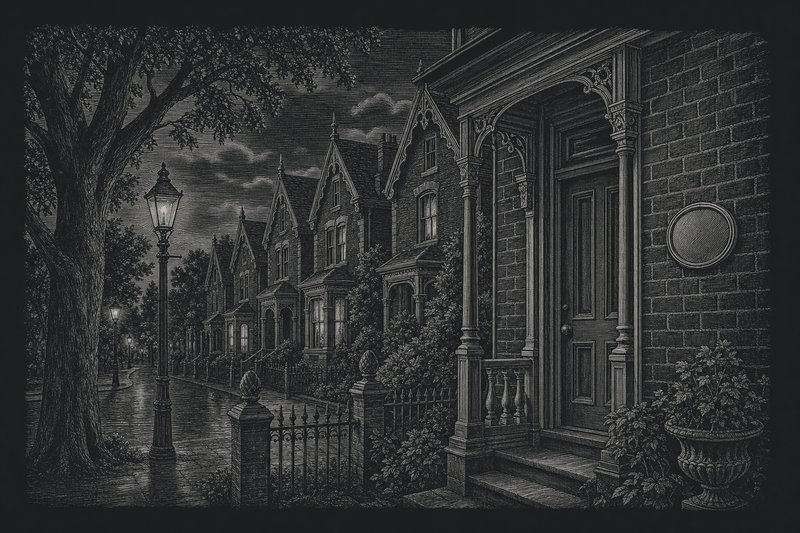
Most of Cabbagetown’s history was lived indoors, in small rooms behind brick fronts, by people who never expected anyone to write it down. The houses survived; the people mostly did not leave a trace. That is why the neighbourhood’s plaques matter. They put a name and a trade back on a particular front door, and after a few blocks a pattern appears: writers, painters, musicians, scientists and reformers, many of whom arrived here with very little.
This page is a short guide to those names and where to find them. The longer story of the streets is on the history page, and the story of the name itself on why it is called Cabbagetown.
The blue oval plaques
The plaques belong to Cabbagetown People, a program of the Cabbagetown Preservation Association. A small group of volunteers began researching former residents in 2001, and the association now counts more than 60 blue oval plaques on houses across the neighbourhood, with close to 100 biographies on the program’s website. The subjects are people who lived here for a significant time or whose work was bound up with the place, and a few are people laid to rest in its two cemeteries.
These are neighbourhood plaques, separate from the City’s Heritage Toronto markers. They are easy to miss beside a door frame, and they are fixed to private houses, so read them from the sidewalk.
Hugh Garner and the book that named a slum
No resident is more tied to Cabbagetown than Hugh Garner, the writer whose novel gave the neighbourhood’s name its most lasting picture. The Canadian Encyclopedia records that he was born in Batley in England in 1913, that his parents brought the family to Canada in 1919, and that his father left soon after. He grew up poor in these streets, worked as a copy boy at the Toronto Star, rode freight trains during the Depression, fought in the Spanish Civil War and served at sea in the Second World War.
The neighbourhood remembers him in three separate ways, and they are easy to mix up.
- His plaque is on Ontario Street, where the association lists him as “author and witness to Depression-era Cabbagetown”.
- The Hugh Garner Housing Co-operative stands at 550 Ontario Street. The lane-naming notes of 2010 give that address as the site of his childhood home, long since demolished. The co-op was built in 1983 and in 2010 added a green roof that was billed at the time as the largest residential one in Canada.
- Garner Lane, south of Wellesley Street East and east off Ontario Street, is one of the lanes the City named in 2009 and 2010. Its official name is Garner Lane, not Hugh Garner Lane.
Writers, artists and scientists on the plaque list
The association’s street-by-street list is the best way to see who lived where. A few names show its range.
Al Purdy, the poet, lived at 435 Sackville Street as a young man. His biography on the program’s site describes him watching the life of the neighbourhood and spending time at the Riverdale Zoo, which then occupied the grounds of today’s Riverdale Farm. He wrote 33 books of verse and twice won the Governor General’s Award. Al Purdy Lane runs east of Sackville, south off Salisbury Avenue.
Ernest Thompson Seton, the naturalist and artist remembered for the realistic animal story, has his plaque on Aberdeen Avenue. He spent his boyhood in Ontario, moved to the United States in 1896, and in 1910 joined Robert Baden-Powell and Daniel Beard in establishing the Boy Scouts of America.
Walter Allward, the sculptor of the Canadian National Vimy Memorial in France, is marked on Amelia Street. Early in his career he modelled terracotta panels at the Don Valley Brickworks, a short way up the valley.
On Sackville Street the list continues with Arthur Schawlow, who shared the 1981 Nobel Prize in Physics, the war artist Jack Nichols and the Czech-Canadian novelist Josef Škvorecký. Amelia Street has Betty Oliphant, who shaped ballet education in Canada. On Parliament Street the plaque list names Ben Wicks, the cartoonist and literacy campaigner, and on Salisbury Avenue Eden Smith, the architect whose firm designed Spruce Court.
Details on each come from the association’s own biographies. For anything beyond the name and the street, read the full entry on its site.
Lanes with names
Cabbagetown’s back lanes were anonymous for most of their history. In 2009 and 2010 the City of Toronto gave names to dozens of them, working from proposals researched by the Cabbagetown Preservation Association with the local councillor’s office. Some honour residents, such as Garner Lane and Al Purdy Lane. Others recall the trades, plants and animals of the old neighbourhood. The names are posted at the lane entrances off the main streets.
Names in the two cemeteries
Many people connected with Cabbagetown are buried at its edges, and the cemeteries page covers both grounds in detail. At the Toronto Necropolis, Heritage Toronto has told the stories of the Black families buried there: Thornton and Lucie Blackburn, who escaped slavery, started the city’s first cab service and were named National Historic Persons by the federal government in 1999; and Wilson Ruffin Abbott, the first Black city councillor, with his son Anderson Ruffin Abbott, one of the first Black Canadians licensed to practise medicine. Lucie Blackburn raised the red granite obelisk over her husband’s grave in 1890 and was buried beside him five years later.
St. James Cemetery on Parliament Street has a different kind of name on it. Its curving paths were laid out in 1842 by John George Howard, the architect and surveyor who later gave the city High Park. One name it does not hold is Bishop John Strachan’s. The cemetery belongs to the Cathedral Church of St. James, which leads many visitors to look for his grave here, but Strachan was buried at the cathedral itself.
Seeing the plaques on foot
The plaques are spread over the residential streets on both sides of Parliament, among them Sackville, Amelia, Aberdeen, Winchester and Carlton to the east and Ontario Street to the west. The heritage walk passes several of these streets, and a detour of a block or two off the route will find more. The association’s website lists every plaque street by street.
Keep to the sidewalk. Every plaque is on a private house, and the people living there now did not choose to have a famous predecessor.
Questions
What are the blue plaques in Cabbagetown?
They are the neighbourhood plaques of the Cabbagetown People program, run by volunteers of the Cabbagetown Preservation Association since 2001. More than 60 blue oval plaques mark houses where notable residents lived, and the program's website holds close to 100 biographies.
Did Hugh Garner live in Cabbagetown?
Yes. He grew up in the neighbourhood, and the City's 2010 lane-naming notes place his childhood home at 550 Ontario Street, since demolished. The Hugh Garner Housing Co-operative stands on Ontario Street today, and a lane nearby is named Garner Lane.
Which famous people lived in Cabbagetown?
The plaque list includes the writer Hugh Garner, the poet Al Purdy, the naturalist Ernest Thompson Seton, the sculptor Walter Allward, the ballet teacher Betty Oliphant, the physicist Arthur Schawlow, the novelist Josef Škvorecký and the cartoonist Ben Wicks, among many others.
Why do Cabbagetown's lanes have names?
In 2009 and 2010 the City of Toronto named the neighbourhood's back lanes on proposals researched by the Cabbagetown Preservation Association. Many honour former residents, such as Garner Lane and Al Purdy Lane; others recall local trades, plants and animals.
Is Bishop John Strachan buried in St. James Cemetery?
No. The cemetery on Parliament Street belongs to the Cathedral Church of St. James, but Strachan, the first Anglican bishop of Toronto, was buried at the cathedral itself, downtown at King and Church Streets. The two sites are often confused.