HomeThe two cemeteries
The Toronto Necropolis and St. James Cemetery: A Guide for Visitors
Two Victorian cemeteries hold Cabbagetown's northern and eastern edges. Between them lie a first mayor, a Father of Confederation, a rebel of 1837 and a champion oarsman, beside some of the finest Gothic Revival buildings in the city.
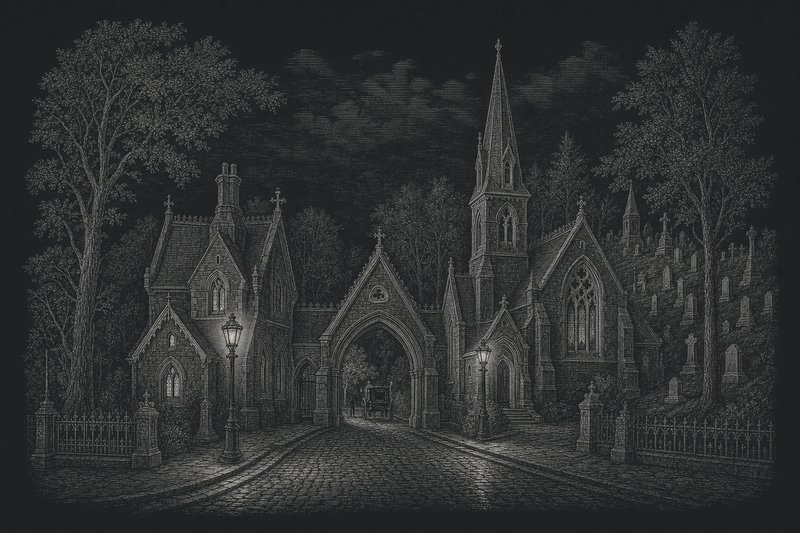
Walk to the end of Winchester Street and the road simply stops at a gate. Beyond it, under old trees, the ground falls away toward the Don Valley in rows of stones. That is the Toronto Necropolis, and just to the north-west, along Parliament Street, lies St. James Cemetery. Together they bracket Cabbagetown on two sides, and between them they hold a large share of nineteenth-century Toronto.
This page covers both: how each began, the two chapels that are among the finest Gothic Revival buildings in Toronto, the people buried there, and how to visit respectfully. Both are working cemeteries. That shapes everything about a visit.
The Toronto Necropolis
The Necropolis dates from the 1850s. It replaced the Strangers’ Burying Ground, an earlier cemetery that had opened in 1826 and closed in 1855. The Necropolis took its place on high ground above the Don, and the setting on the valley rim is still what gives it its atmosphere.
Today the Necropolis holds more than 50,000 graves. It is managed by Mount Pleasant Group of Cemeteries as trustee, and its entrance is at 200 Winchester Street, directly across from the gates of Riverdale Farm.
Henry Langley’s gate and chapel
The buildings at the gate are the reason many people come. In 1872 the architect Henry Langley designed the chapel, the covered carriage porch (the porte-cochère) and the superintendent’s lodge as a single group. They are Gothic Revival: yellow brick, pointed windows with stained glass, buttresses and steep gables under roofs of patterned slate in three colours. The square tower on the east side throws the composition off balance on purpose, giving it the picturesque, irregular silhouette that the Victorians loved in Gothic design.
The gatehouse carries carved wooden trim on its gables, the same kind of ornament that turns up on the bargeboards of Cabbagetown’s houses a few streets away. If you have been looking at house styles on the way in, the connection is easy to see.
Langley died in 1907 and is buried in the Necropolis, a short walk from the chapel he designed.
Who is buried in the Necropolis
The list of burials reads like a short history of the city. William Lyon Mackenzie, Toronto’s first mayor and the leader of the Upper Canada Rebellion of 1837, lies here. So does George Brown, a Father of Confederation and founder of The Globe newspaper. Joseph Bloore, whose name, minus a letter, survives in Bloor Street, is buried in the Necropolis, as is Ned Hanlan, the champion oarsman of the late nineteenth century.
Some of the most moving graves belong to people whose stories are less well known. Thornton Blackburn escaped slavery in the United States through the Underground Railroad, settled in Toronto and founded the city’s first cab company. Anderson Ruffin Abbott and his father Wilson Ruffin Abbott are here too. And a memorial remembers Samuel Lount and Peter Matthews, the two men hanged for their part in the 1837 Rebellion.
A side note that surprises most visitors: in 1933 the Necropolis opened the first crematorium in Ontario, in the chapel’s basement. It was decommissioned in 1990, when cremations moved to a facility at Mount Pleasant Cemetery.
St. James Cemetery
St. James Cemetery opened in July 1844, which makes it the oldest cemetery in Toronto still in use. It belongs to the Cathedral Church of St. James and began as an Anglican burial ground, later opening to all denominations. The main entrance is at 635 Parliament Street, just north of Wellesley Street, and the grounds run north toward Bloor Street along the east side of Parliament.
It was laid out as a “rural cemetery,” the nineteenth-century idea of a burial ground as a landscaped park with winding paths and planted trees. That character survives. The cemetery is large, quiet and green, and a walk through it feels more like a park than a churchyard. The St. James Town neighbourhood to the west takes its name from it.
The Chapel of St. James-the-Less
Just inside the main gates, on a small landscaped rise, stands the Chapel of St. James-the-Less. It was designed by the architects Cumberland and Storm, built in 1860 and opened in 1861, and it is a Victorian Gothic funeral chapel of unusual quality. Its spire makes it easy to pick out from Parliament Street. It was designated a National Historic Site of Canada in 1990.
The chapel predates the Necropolis buildings by a little over a decade, and the two are worth seeing on the same walk. Both are Gothic Revival, but St. James-the-Less is taller and more vertical, while Langley’s group at the Necropolis is lower and spread out. Different architects, the same century, two answers to the same question.
Who is buried at St. James
The cemetery has over 95,000 interments. It holds many of the families who built nineteenth-century Toronto’s businesses, including William Gooderham and James Worts of the Gooderham and Worts distillery, and James Austin, founder of the Dominion Bank. Political figures include two premiers of Ontario: Edward Blake, who took office in 1871, and John Robarts, premier from 1961 to 1971. There are also 42 Commonwealth war graves from the two world wars.
One tree has a story of its own: a copper beech planted by the Prince of Wales, later King Edward VIII, during his visit to Canada in 1919.
Visiting the two cemeteries
Both cemeteries welcome visitors on foot during gate hours. Mount Pleasant Group lists the Necropolis gates as open from 8 am to 8 pm between April 1 and October 31, and from 8 am to 5:30 pm from November 1 to March 31. St. James Cemetery opens its grounds seven days a week, from 8 am to 5 pm in standard time and 8 am to 7 pm in daylight saving time. Either may close temporarily after storms or ice, while the paths are made safe. St. James has also noted that construction work has limited access to some of its roadways.
These are active burial grounds. Keep to the paths, keep your voice down, and give a funeral or a grieving family plenty of room; if a service is under way near a grave you wanted to see, come back later. Photograph the buildings and the landscape, never mourners.
The two sites link naturally with the rest of Cabbagetown. The Necropolis is a stop on the heritage walk, right after the farm, and St. James sits at the northern end of the route along Parliament Street. The history page explains how the neighbourhood grew up between the two cemeteries, and the Riverdale Park page covers the valley below the Necropolis rim.
Walking between the two
The two cemeteries do not share a gate, so the walk between them runs through the streets. From the Necropolis entrance at 200 Winchester Street, head west along Winchester, lined with Victorian houses, to Parliament Street. Turn north, cross Wellesley Street, and the main gate of St. James Cemetery is at 635 Parliament, just beyond the corner. At an easy pace it is a quarter of an hour, and most of it is past private houses, so the same courtesy applies on the pavement as inside the gates.
If you are following the heritage walk, this stretch is already part of the route: the Necropolis comes right after the farm, and St. James closes the loop on Parliament Street. The walk map shows both gates.
Finding a particular grave
Both cemeteries are large, with the winding paths of their period. Mount Pleasant Group publishes a key map of the Necropolis, and St. James offers a cemetery map to help visitors find their way. For a specific family grave, the offices are the place to ask: the Necropolis office works by appointment, while the St. James office keeps weekday hours plus a short Saturday morning and is closed on Sundays and statutory holidays.
A practical aside for family historians: an inscription on a stone is only part of the record. Cemetery offices keep burial records, and a stone that has weathered to near illegibility may still be traceable through them. Ask before assuming a grave is lost.
When to go
Spring and autumn suit both cemeteries best. The trees are the point of a rural-style cemetery, and they are at their finest when the leaves are coming out or turning. Summer gives the longest gate hours, open into the evening at both, while winter shortens them and can close paths after ice or heavy snow. A weekday morning is the quietest time, and the least likely to coincide with a funeral. Whatever the season, check the gate hours before setting out late in the day, because the two cemeteries close at different times.
Which one to visit first
If you only have time for one, choose by what you want to see. For the buildings, the Necropolis gate group is the more complete picture: chapel, porch and lodge in one view, with the valley behind. For atmosphere and space, St. James is the larger, calmer landscape, with the chapel on its rise just inside the gate.
Seen together, they explain the shape of Cabbagetown. The neighbourhood filled the land between an 1840s cemetery to the north and an 1850s one to the east, and neither could ever be built over. The houses stop where the graves begin.
Questions
Where is the Toronto Necropolis?
The Toronto Necropolis is at 200 Winchester Street, at the eastern end of Cabbagetown on the rim of the Don Valley. Its Gothic gatehouse faces Winchester Street, opposite the entrance to Riverdale Farm.
Who is buried in the Toronto Necropolis?
Notable burials include William Lyon Mackenzie, Toronto's first mayor and leader of the 1837 Rebellion; George Brown, a Father of Confederation and founder of The Globe; Joseph Bloore, after whom Bloor Street is named; the oarsman Ned Hanlan; Thornton Blackburn; and Samuel Lount, with a memorial to Lount and Peter Matthews.
Who designed the Necropolis chapel?
The chapel, the gate and the superintendent's lodge were designed by the architect Henry Langley and built in 1872 in the Gothic Revival style, in yellow brick with multicoloured slate roofs. Langley himself is buried in the Necropolis.
What are the Toronto Necropolis gate hours?
Mount Pleasant Group lists the gates as open from 8 am to 8 pm between April 1 and October 31, and from 8 am to 5:30 pm between November 1 and March 31. The gates can close temporarily in bad weather.
When did St. James Cemetery open?
St. James Cemetery opened in 1844 and is owned by the Cathedral Church of St. James. It is the oldest cemetery in Toronto still in use, and began as an Anglican burial ground before becoming non-denominational.
What are the St. James Cemetery hours?
The cemetery lists its grounds as open seven days a week, from 8 am to 5 pm in standard time (November to March) and 8 am to 7 pm in daylight saving time (March to November). The office keeps shorter weekday hours.
What is the Chapel of St. James-the-Less?
It is the Victorian Gothic funeral chapel just inside the main gates of St. James Cemetery, designed by the architects Cumberland and Storm, erected in 1860 and opened in 1861. The federal designation as a National Historic Site dates from 1990.
Can you walk through the cemeteries?
Yes. Both are working cemeteries that welcome visitors on foot during gate hours. Keep to the paths, give funerals and mourners room, and remember that these are active burial grounds. The heritage walk passes the Necropolis gate.
Was there a crematorium at the Necropolis?
Yes. In 1933 the Toronto Necropolis opened Ontario's first crematorium. It was decommissioned in 1990 in favour of a facility at Mount Pleasant Cemetery.