HomeRiverdale Farm
Riverdale Farm in Toronto: The Animals, the Hours and How to Visit the Farm in Cabbagetown
Cows, pigs and a Pennsylvania bank barn at the end of a street of Victorian houses. Riverdale Farm is free, open every day of the year, and sits on the ground where Toronto kept its zoo for eighty years.
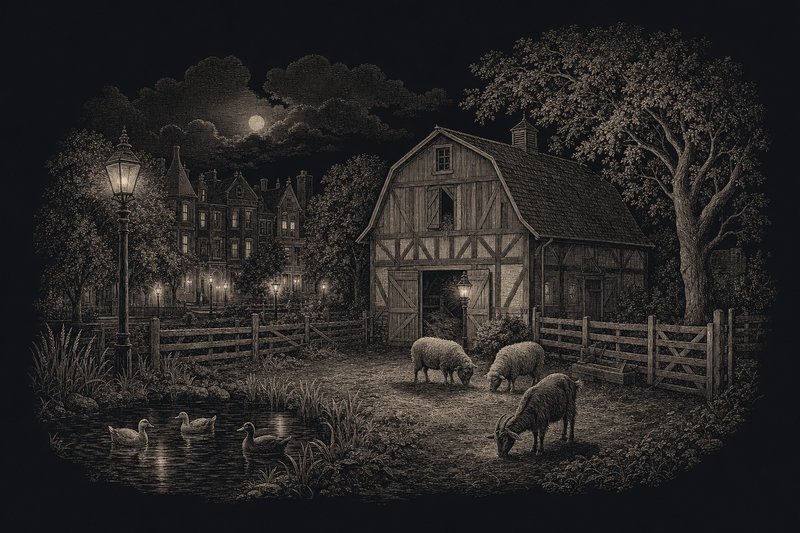
Most city farms feel like a stage set. Riverdale Farm does not, and Riverdale Farm Toronto visitors notice it within a minute of walking in. The barns are real barns, the smell is a real farm smell, and on a weekday morning the loudest sound at the end of Winchester Street is often a rooster. It is a working farm run by the City of Toronto, three hectares on the edge of the Don Valley, free to walk into and open every day of the year.
For anyone exploring Cabbagetown, Riverdale Farm Toronto is the natural end of the walk east. The Victorian houses run right up to its gates, the farmers’ market sets up outside it on Tuesdays, and the valley opens below. This page covers the hours and rules, the animals and buildings, the long history of the site and how to get there.
Riverdale Farm hours, admission and rules
Riverdale Farm is open 7 days a week, 365 days a year, including public holidays, from 9 am to 5 pm. Admission is free. The address is 201 Winchester Street, and the main entrance faces Winchester near Sumach Street.
A few rules keep the farm working. Dogs are not allowed on the farm, and neither are bicycles, skates, scooters or ride-on toys. If you arrive with a dog, Riverdale Park wraps around the farm and has an off-leash area, so one person can wait outside while the others walk through.
The farm sits on a slope, and some of the paths are steep. The Simpson House has wheelchair access on its north side. Public washrooms and baby changing facilities are in the Meeting House. Picnic tables can be booked through the City; the farm’s site lists the contact.
The hours above were checked against the farm’s own site in September 2026. It costs nothing to look again before a holiday visit.
The Riverdale Farm animals
The farm keeps cows, horses, goats, sheep, pigs, chickens, turkeys, ducks and geese. Its particular focus is on heritage breeds: older types of farm animal, often described as pioneer breeds, that are hard to find on commercial farms. That choice gives the place its character. The pigs and sheep look noticeably different from the ones in a supermarket photograph, and the poultry yard is a mix of shapes and colours.
The Riverdale Farm animals are spread across paddocks and barns rather than kept in a single yard, and the waterfowl have the pond, with the Island House beside it. The Pig and Poultry Barn holds what its name says. Walk the whole loop slowly and you will pass all of them.
Every day at 11:30 am, a farmer presents a different animal to visitors in the Lower Francey Barn. It is the best time to arrive with children: the animal is out, the farmer explains what it is and how it is looked after, and questions are welcome. You, reading this with a small person at your side, might want to plan the morning around it.
Seasons change the visit more than the animals. Summer weekends are busy and hot. Autumn and winter are quieter, with fewer visitors and the barns at their most atmospheric.
The barns and buildings
The oldest building on the farm is older than the farm by more than a century. The Francey Barn was built in 1858 on a farm in Markham Township and moved to this site in 1977. It is a Pennsylvania bank barn, a type built into a slope so that the upper floor can be reached from the high side and the lower floor from the low side. That design suits the Don Valley edge perfectly, which is part of why it looks so settled on a site it was moved to.
The Simpson House is a Victorian-style farmhouse, built as a reproduction to match the period of the farm, and it holds public facilities. The Pig and Poultry Barn, the Drive Shed and the Island House by the pond complete the working buildings. The Meeting House, completed in 1993, is the base for classes and year-round programs.
A walk round the farm
The farm is small enough to see in an hour and varied enough to fill a morning. A loop that takes in everything passes the Simpson House, the Victorian-style farmhouse with the public facilities; the Francey Barn, where the 11:30 am animal presentation takes place in the lower level; the Pig and Poultry Barn and the Drive Shed; and the pond with the Island House.
The Meeting House, completed in 1993, is the farm’s base for year-round programs and has the public washrooms and baby changing facilities. It is the obvious place to pause with children.
Two small pieces of advice. First, wear shoes that can cope with mud: these are farm paths on a slope, and they show it after rain. Second, if you want to see the Riverdale Farm animals up close with someone to explain them, plan around the daily presentation, which gives the visit a focus.
Nearby, before or after
The farm sits at the meeting point of three things worth combining. Across Winchester Street is the gate of the Toronto Necropolis, with Henry Langley’s Gothic Revival chapel and lodge from 1872. Below the farm is Riverdale Park, with the footbridge to the east side and its view of the skyline. And a short walk west along Winchester leads back into the Victorian side streets and on to Parliament Street, where the neighbourhood’s cafés and restaurants are.
On Tuesday afternoons in the warm months, the order almost chooses itself: farm first, then the farmers’ market that sets up outside the gates in the middle of the afternoon, then a slow walk back up Winchester as the afternoon ends.
From Riverdale Zoo to Riverdale Farm in Toronto
For eighty years this slope was a zoo. The City of Toronto dates the Riverdale Zoo from 1894 to 1974. Over those decades Torontonians came down to the valley to see animals that had nothing to do with farming. When the collection outgrew the site, it moved to the new Toronto Zoo in Scarborough, and the old grounds on Winchester Street were left empty.
The grounds were turned into a farm. Riverdale Farm opened on September 9, 1978, the year after the Francey Barn arrived from Markham, and it has run on the same land ever since: farm animals where exotic ones used to be, on a slope with a century of animal history.
The farm has not always been secure. In 2011, it was among City operations recommended for closure during budget cuts. Private and corporate donations, beginning with a gift from the W. Garfield Weston Foundation in 2013, helped keep it open, and the Riverdale Farm Stewardship Group was established the same year to support it.
Events at Riverdale Farm
The farm runs a calendar of seasonal events alongside its daily routine. The Fall Festival is a two-day September weekend of farm activities, listed on the farm’s site with corn shucking, hog and chicken calling and a pancake breakfast. In late October, the Halloween Boo Barn brings pumpkin carving, crafts and a walk through a decorated barn; a donation is usually suggested for the pumpkins, with the money going to the farm.
Classes run seasonally from September to June, and summer camp programs fill the July and August weeks. These are booked through the City of Toronto’s recreation registration, not at the gate.
Because event dates move every year, the farm’s own calendar is the only reliable guide. The dates on third-party listings are often a year out of date.
Getting to Riverdale Farm, Toronto
The farm’s own directions are the best: take Line 2 of the subway to Castle Frank station, board the 65 Parliament bus southbound, get off on Parliament Street at Winchester Street, cross Parliament and walk about ten minutes east along Winchester. That walk is a good introduction to Cabbagetown in itself, with bay-and-gable houses on both sides and the Toronto Necropolis at the end of the street.
From elsewhere in Cabbagetown, the farm is at the bottom of almost any eastbound side street. The heritage walk in this guide passes the farm gates, and the walk map shows where it sits in relation to the other stops. On a Tuesday in the warm months, time the visit to finish as the farmers’ market opens outside the gates in the afternoon.
Visiting with a group
The City runs classes at the farm from September to June and summer camp programs in July and August, and the Meeting House is the base for them. Anyone bringing a larger party on their own should remember that the barns fill quickly and that the animals do better with quiet visitors. For a structured visit, the farm’s programs are booked through the City of Toronto, and the farm’s contact details are on its own site.
Riverdale Farm and the neighbourhood
Riverdale Farm is part of what makes Cabbagetown unusual. Few downtown neighbourhoods anywhere have a working farm at the end of a residential street, and fewer still have one set on an old zoo site with a nineteenth-century barn moved in from the countryside. Residents walk through it on the way to the park. Visitors often come for the farm and stay for the streets.
The places page lists the other spots nearby. The closest is the Necropolis, just north along the valley rim, whose Gothic gatehouse is a few minutes’ walk from the farm gate.
Questions
What are the Riverdale Farm hours?
Riverdale Farm is open from 9 am to 5 pm, seven days a week and 365 days a year, including public holidays. Those hours come from the farm's own site; confirm them there before a holiday visit.
Is Riverdale Farm free?
Yes. Admission to Riverdale Farm is free every day. Some seasonal events ask for a donation for particular activities, such as a pumpkin at the Halloween event, but walking in and seeing the animals costs nothing.
Where is Riverdale Farm in Toronto?
The farm is at 201 Winchester Street, at the eastern end of Cabbagetown where the streets meet the Don Valley. It sits on the upper slope of Riverdale Park West, next to the Tuesday farmers' market.
What animals are at Riverdale Farm?
The farm lists cows, horses, goats, sheep, pigs, chickens, turkeys, ducks and geese. It concentrates on older, heritage breeds of farm animals that are hard to find on commercial farms. A farmer presents a different animal each day at 11:30 am in the Lower Francey Barn.
Can I bring my dog to Riverdale Farm?
No. The City of Toronto does not allow dogs on the farm, and the same rule covers bicycles, skates, scooters and ride-on toys. Dogs are fine in the surrounding Riverdale Park, which has an off-leash area.
Was Riverdale Farm a zoo?
The site was the Riverdale Zoo, which the City dates from 1894 until 1974, when the animals moved to the new Toronto Zoo in Scarborough. Riverdale Farm opened on the same ground on September 9, 1978.
Do you need tickets for Riverdale Farm?
No tickets are needed for general entry. Classes, camps and some seasonal activities are booked separately through the City of Toronto, so check the farm's calendar if you are planning around a program.
What is the Boo Barn at Riverdale Farm?
The Halloween Boo Barn is an autumn family event at the farm with pumpkin carving and crafts and a walk through a decorated barn. Dates change each year, usually on an October weekend, and the farm posts them in its calendar.
Is Riverdale Farm accessible?
The farm is on a slope and some paths are steep. Wheelchair access to the Simpson House is on its north side, and the Meeting House has public washrooms and baby changing facilities.
How do I get to Riverdale Farm by TTC?
The farm suggests taking Line 2 to Castle Frank station, then the 65 Parliament bus south to Winchester Street, crossing Parliament and walking about ten minutes east along Winchester. The walk passes some of Cabbagetown's best Victorian houses.
Who runs Riverdale Farm?
The City of Toronto owns and operates the farm through Parks, Forestry and Recreation. The Riverdale Farm Stewardship Group, established in 2013, supports it.