HomeThe flag
The Cabbagetown Flag: What It Shows and Where to Buy One
Green on the outside, white in the middle, and on the white a single cabbage. A neighbourhood flag that is also a joke about its own name.
Free to use
Put the flag on your page
This drawing of the flag may be used on any website, school project or neighbourhood notice. Copy the code below and paste it into the page; it shows the flag and links back to this page.
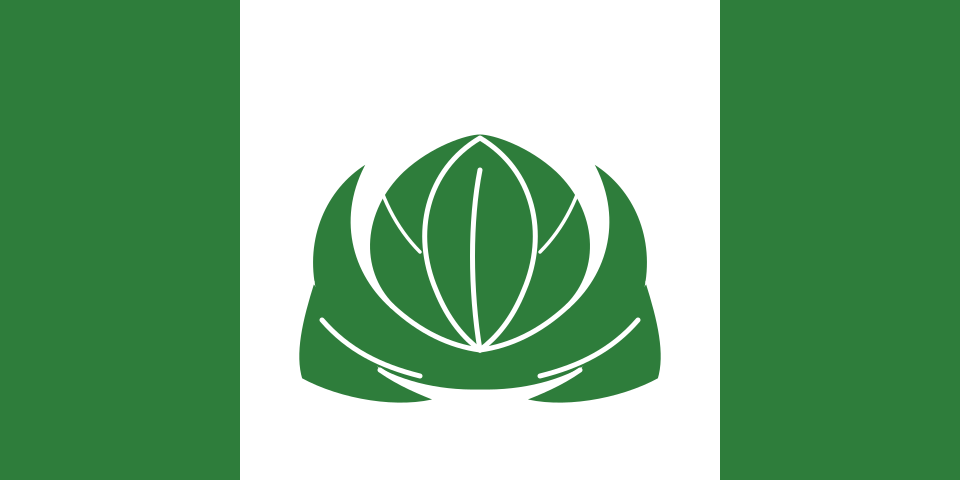

Some neighbourhood flags need a caption. The Cabbagetown flag does not: green and white, with a vegetable in the middle, it is exactly as literal as the name.
What the flag shows
The design is simple enough to describe in one sentence. The Flags of the World project, which collects and documents flags from every country, region and city it can find, records it as a green field with a white Canadian pale and a green cabbage on the pale.
The “Canadian pale” is the part that makes it look familiar. It is the broad white band in the centre of the Maple Leaf flag, a square taking up half the flag’s width, with coloured bands on either side. On the national flag those bands are red and the emblem is a maple leaf. On the Cabbagetown flag the bands are green and the emblem is a cabbage. Anyone who grew up in Canada reads the layout instantly, which is the point of the joke.
The contributor who first reported the flag to the project in August 2010, Jan Mertens, summed it up: “Once seen, never forgotten!” It is hard to argue.
Two cabbages
The layout has stayed the same, but the cabbage has not. In August 2018 another contributor, Ivan Sache, documented two different designs that differ only in the way the cabbage is drawn. One turns up in pictures from roughly 2009 to 2014, the other in photographs from 2014 and 2015 onward.
That is normal for a flag that is produced in batches for a neighbourhood rather than fixed by law. It also means there is no single “correct” cabbage. The drawing on this page follows the layout exactly and draws the cabbage in its own way, as a heraldic head of leaves with its veins picked out in white.
How the drawing here was made
The drawing on this page follows the layout exactly as the Flags of the World entry records it and as the Canadian flag defines it: a flag twice as long as it is high, with the white centre taking up half the length and the two green bands a quarter each. The green is a mid, slightly deep green; the white is plain white; there is no border and no lettering.
The cabbage in this drawing is new; it copies neither of the versions in circulation. It is a single head of leaves, seen from the front, with the midribs and a few veins picked out in white so that it reads at small sizes. That makes it suitable for a website header or a printed notice, where a detailed botanical cabbage would turn into a green blob. If you need the official artwork for a banner or a flag of your own, the business association that sells the flag is the place to ask.
Both files are free to download from the panel above: a scalable SVG for screens and print, and a JPEG for places that do not accept SVG. The embed code places the drawing on another page with a link back here, which is the only thing asked in return.
Where the flag comes from
The flag is sold by the Cabbagetown business improvement area, the association of merchants along Parliament Street and the surrounding blocks. The association was formed in 1982, first of all to run the Cabbagetown Festival, and it still sells the flag from its office at 237 Carlton Street, on the corner of Parliament.
In September 2026 its shop listed a heavyweight outdoor flag in two sizes, small at 18 by 36 inches and large at 36 by 60 inches, priced from CA$35, for pick-up only, Tuesday to Thursday from 10 a.m. to 4:30 p.m. Hours and prices change, so check the shop before making the trip. It travels, too: a question on the website Ask MetaFilter once asked, in so many words, how to get one to New York.
Why a vegetable works
Most neighbourhood flags fail because nobody can remember what is on them. This one has the opposite problem: once you know the name, you cannot unsee it. The cabbage connects the flag straight to the story every local tells about the name, the front-yard gardens of the 1840s, and it does so without a word of text.
There is also something fitting about the green. The streets that carry the name today are heavily tree-lined, and the City’s heritage plans single out the canopy over streets and yards as part of the district’s character. A flag that is mostly green hangs well in front of them.
Seeing it in person
Keep an eye on porches and shop windows along the heritage walk, and on the street stalls during the September festival on Carlton and Parliament Streets. The history page explains how the houses under those porches came to survive.
Whether a flag sold by a merchants’ association counts as a neighbourhood’s official emblem is a nice question. Nobody in Cabbagetown seems in a hurry to settle it.
Questions
What does the Cabbagetown flag look like?
It has a green field with a white Canadian pale, the wide white central square familiar from the national flag, and a green cabbage on the white. That is how the Flags of the World project records it. There is no text, no date and no second emblem, which is a large part of why it is so easy to recognize.
Where can a Cabbagetown flag be bought?
The Cabbagetown business improvement area sells it through its online shop, for pick-up at 237 Carlton Street at Parliament. In September 2026 it was listed as a heavyweight outdoor flag in two sizes, 18 by 36 inches and 36 by 60 inches, from CA$35, with pick-up Tuesday to Thursday, 10 a.m. to 4:30 p.m. Check the shop before going.
Why is there a cabbage on the flag?
Because of the name. The usual story is that Irish immigrants in the 1840s grew cabbages in their small front yards, and the district was nicknamed after them. The flag takes the joke and makes it a badge. The page on the name goes through the story and where it first applied.
Has the design changed?
The layout has stayed the same, but the cabbage has not always been drawn the same way. In 2018 a contributor to Flags of the World documented two versions that differ only in how the cabbage is rendered, one seen in pictures from about 2009 to 2014, the other in photographs from 2014 and 2015 onward.
Can the drawing on this page be used elsewhere?
Yes. The drawing on this page may be used on websites, school projects and neighbourhood notices, and the embed code above shows it with a link back here. It is an illustration of the design as described, not the official artwork, so anyone who needs a flag to fly should buy the real one.