HomeAllan Gardens
Allan Gardens Conservatory in Toronto: A Guide to Visiting the Palm House and Park
A glass dome and six greenhouses on the far side of Sherbourne Street, open every day of the year and free to walk into. For anyone exploring Cabbagetown, it is the obvious first stop and the warmest one in January.
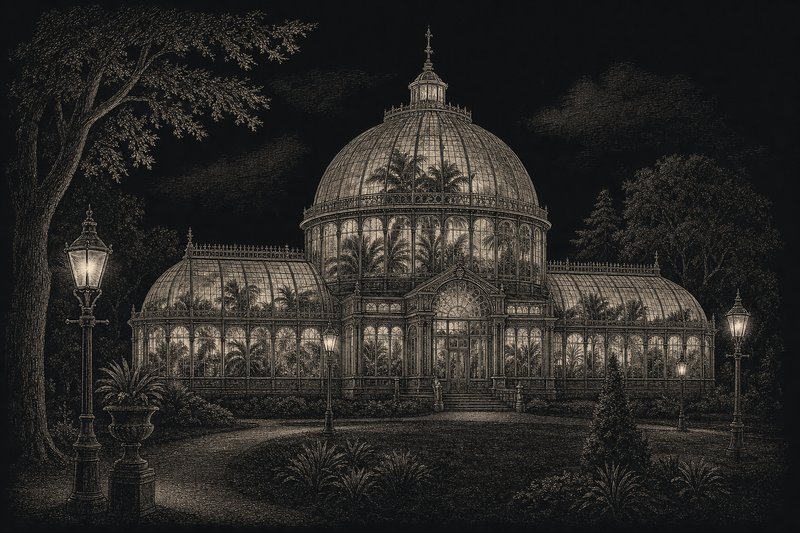
On a grey February afternoon, the quickest way to feel warm in downtown Toronto is to push open the door of a greenhouse on Gerrard Street. The Allan Gardens Conservatory has been doing that job for more than a century. The glass dome at its centre is the Palm House, the other greenhouses spread out from it in wings, and the whole complex is free and open every day of the year. For a guide to Cabbagetown, that makes it the natural place to begin: it sits a few blocks west of the Victorian streets, it is easy to find, and it sets the tone for a neighbourhood that is mostly about the nineteenth century.
This page covers the practical side (hours, admission, permits, getting there), what is inside each greenhouse, the long history of the site, and how Allan Gardens fits into a walk through Cabbagetown. The opening hours and permit rules below were checked against the City of Toronto and the Friends of Allan Gardens in September 2026. They change occasionally, so treat them as a starting point and confirm before a special trip.
Visiting Allan Gardens: hours, admission and the basics
The Allan Gardens Conservatory is open from 10 am to 5 pm, seven days a week and 365 days a year, with last entry at 4:45 pm. Admission is free. There is no timed entry, no ticket desk and no booking for an ordinary visit, which surprises people who arrive expecting a botanical-garden price. The address is 160 Gerrard Street East, and the main doors face south onto Gerrard.
The park around the greenhouses is a public City park and can be crossed at any time. What closes at five is the glass. If you are coming late in the day in winter, the light inside goes early and the Palm House is at its best before three.
A few house rules are worth knowing before you arrive. Service animals are welcome inside, pets are not. There is no coat check and there are no lockers, so a winter visit means carrying your coat through houses kept at tropical temperatures. Accessible washrooms are in the Orchid and Bromeliad House and follow the conservatory’s hours. The Friends of Allan Gardens say they try to keep programs and events barrier-free and invite visitors with specific access questions to contact them directly.
There are no Allan Gardens tickets for general admission, and no one sells them. Tickets, fees and bookings belong to a different kind of visit: a wedding ceremony, a professional photo shoot or a film crew. Those are covered further down.
Inside the Allan Gardens Conservatory
The City of Toronto describes the conservatory as a set of show houses, each kept at its own climate. Walking them in a loop takes about an hour at an easy pace. Most people walk in through the Palm House and let the connecting doors decide the order.
The Palm House
The Palm House is the reason people photograph Allan Gardens. It is a domed glass building on a classical plan, designed by the architect Robert McCallum and opened in 1910, and it is the oldest part of the complex still standing. Inside, the dome rises over tall palms and tree-sized tropical plants, with walkways at ground level and a view straight up into the ironwork.
The Allan Gardens Palm House went through a full restoration in recent years. The Friends of Allan Gardens record that it reopened on May 17, 2025, and the work shows: the glazing is clear, the paint is fresh and the building no longer looks tired. If you have not been since before the restoration, it is worth a second visit for the dome alone.
A small aside for anyone interested in how these buildings were used: the Palm House was never a museum. It was built as a public winter garden for a city that had very few warm indoor spaces open to everyone, and it still works that way. On weekday mornings in January it fills with people who have simply come in from the cold.
The other greenhouses
Beyond the Palm House, the City lists the show houses by their climate. The Tropical house holds humid, broad-leafed plants. The Arid house is the desert room, with cacti and succulents on sand. The Orchid and Bromeliad house is the most detailed of the rooms, and the one to slow down in. The Temperate house is where the seasonal flower shows are staged, so its contents change several times a year.
The sixth greenhouse is the Children’s Conservatory. It was added in 2003–2004 with funding from the University of Toronto and TD Bank, and it is used for programs and school groups as much as for display. The City’s own history notes that the University of Toronto donated the final building to the complex in 2004.
The seasonal flower shows
The Temperate house carries the flower shows, and the City of Toronto confirms that seasonal shows are staged there. The one most people know is the winter show over the holiday season, when the room is filled with flowering plants and evergreen boughs and the conservatory gets its busiest weeks of the year. Other shows follow through the year as the seasons turn.
Dates shift annually and are announced by the City’s Parks, Forestry and Recreation division. If a show is the point of your trip, look up the City’s conservatory page in the week before you go. Admission stays free during the shows.
A route through the greenhouses
There is no set order, but one loop works well. Enter from Gerrard Street into the Allan Gardens Palm House and give the dome a few minutes, because it is the room most people rush. Then take the connecting doors into the warm, humid houses before the dry ones, so that your glasses fog once rather than twice. The Arid house makes a good middle stop: it is the one room where the plants read as sculpture. Finish in the Orchid and Bromeliad house, where the detail rewards a slow look, and leave through the Temperate house to see whichever seasonal display is up.
Visiting with children changes the plan. Small visitors often lose interest in orchids long before they tire of cacti and palms, so it can help to reverse the order and end under the dome. The Children’s Conservatory is used for programs and school groups, so ask at the door whether it can be seen that day.
If you have a camera, the dome photographs best from the doorway looking in, with the ironwork above and the palms filling the frame. Personal photography is welcome everywhere; tripods and anything that blocks a path fall under the booking rules described below.
A short history of Allan Gardens in Toronto
The land came from George William Allan, who donated five acres to the Toronto Horticultural Society in 1858. The Horticultural Gardens opened on September 11, 1860, and the Prince of Wales, on his tour of British North America that year, planted a maple tree to mark the occasion. In 1864 the City bought the surrounding land, which is how the gardens grew into a block-sized park.
A three-storey wooden pavilion went up in 1879 and became the centre of the gardens for concerts and gatherings. It burned on June 6, 1902. The Palm House, finished in 1910, replaced it, and the complex grew outward from there: two greenhouses in the 1920s, a wing of three more in the mid-1950s, and the Children’s Conservatory in 2003–2004.
The park around the glass is bounded by Carlton Street to the north, Sherbourne Street to the east, Gerrard Street to the south and Jarvis Street to the west. It is mature and shady, with several hundred trees. An assessment in 2008 counted 309 trees of about 47 species, a number that will have changed since.
History here is also about use. The gardens were given to a horticultural society, bought out and extended by the City within a few years, and have been public ever since. That early decision explains the character of the place today: a working city park that happens to contain a Victorian winter garden, used from morning to evening by people who live nearby as much as by visitors.
The park that named a district
The gardens have lent their name to the neighbourhood around them. When residents between Yonge and Sherbourne Streets went looking for a name for their part of the east downtown, the Toronto East Downtown Residents Association chose “Garden District” in recognition of the conservatory, and City Council made the designation official in 2001. The association later renamed itself the Garden District Residents Association.
As the residents define it, the Garden District runs from Carlton Street down to Queen Street, between Yonge and Sherbourne. Its western half is institutional and busy, with Massey Hall, Toronto Metropolitan University and several large churches; its eastern half is mostly residential, with Moss Park and the gardens as its green spaces. Mackenzie House, the museum in the last home of William Lyon Mackenzie, is also in the district. Mackenzie is buried a short walk east of here, in the Toronto Necropolis, which makes an odd and satisfying pair of stops for anyone interested in the 1837 Rebellion.
That places the gardens on a line between two neighbourhoods: the Garden District to the west, which took their name, and Cabbagetown to the east, which took its name from the vegetable plots of its early residents. Gardens on one side, cabbages on the other. The story of the Cabbagetown name is told on its own page.
Allan Gardens and Cabbagetown
Strictly speaking, the gardens are not in Cabbagetown. The park belongs to the Garden District, and Cabbagetown is usually said to begin at Parliament Street, a few blocks east. The two are close enough that most people treat them as one outing, and the walk between them is a good way to see the city change: from the civic scale of the park and the Jarvis Street mansions, across Sherbourne and Parliament, into streets of small red-brick row houses.
The Cabbagetown heritage walk in this guide begins here for exactly that reason. It uses the conservatory as a meeting point and a warm-up, crosses Parliament Street at Carlton, and then heads into the side streets. If you want to see the route before setting out, the walk map marks every stop, and the page on where Cabbagetown begins and ends explains why Parliament Street is the usual boundary.
For a full day, the conservatory pairs well with Riverdale Farm at the other end of the neighbourhood. One is a Victorian winter garden, the other a working farm on the edge of the Don Valley, and both are free. Between them lies most of what Cabbagetown has to show.
Visiting in each season
The park changes more with the seasons than people expect. In winter, the conservatory is the attraction and the park is mostly a way through. The holiday flower show brings crowds on weekends, so a weekday morning is the calm time.
Spring is when the park itself wakes up, and the Temperate house turns over to a new display. Summer brings the lawns into use: picnics, people reading under the trees, dogs being walked along the paths outside. The greenhouses are hot in July and August, and the Arid house in particular can feel like its name.
Autumn is a good compromise. The trees turn, the light is low and warm, and the conservatory is quiet between shows. The Friends of Allan Gardens run community events through the year, including a farmers’ market, seasonal festivals and hands-on workshops. Their calendar is the place to check what is on during your visit.
Photography, weddings and permits
People come here with cameras. The City of Toronto allows quick photography for personal use without any permission at all, which covers the phone photo of the dome and the snapshot of a friend by the orchids.
A booking is needed once a shoot needs set-up, equipment or staging, or exclusive use of a space. The City lists formal photography for wedding proposals, graduation, prom and maternity sessions, and wedding photography, as examples that need a booking. Drones are not allowed in the conservatory or anywhere in the park.
Wedding ceremonies are possible too, and the Palm House is a popular choice. All permits for park facilities are issued by the City of Toronto, not by the Friends of Allan Gardens. The Friends’ permit page links to the City’s application pages for daytime wedding ceremonies, commercial photo shoots and film and television work. Fees, group sizes and time slots are set by the City and change from time to time, so read them on the City’s pages and ignore figures quoted elsewhere.
Visiting in bad weather and with limited mobility
Allan Gardens is one of the few places in this part of the city that gets better in bad weather. Rain on the glass, snow on the roof or a heat wave outside all make the houses feel more like refuges, and the conservatory keeps the same hours whatever the forecast. On the coldest days of the year, expect it to be busier than usual with people who have come in to warm up.
Accessible washrooms are in the Orchid and Bromeliad House, and the Friends of Allan Gardens say they aim to keep programs and events barrier-free. Humid houses mean damp floors from time to time, so take a little care on the paths. For specific access questions, the Friends ask visitors to get in touch before coming.
Getting to Allan Gardens
The conservatory is at 160 Gerrard Street East, and the park fills the block between Jarvis and Sherbourne. The Friends of Allan Gardens describe the site as easy to reach on foot, by TTC and by bike, and that matches experience.
By transit, the 506 Carlton streetcar runs along Carlton Street past the park’s northern edge. From Cabbagetown, walk west along Carlton or Gerrard; from the corner of Parliament and Carlton it is a short walk. Bike lanes run close by.
Parking is the weak point. Neither the City nor the Friends of Allan Gardens advertise a dedicated conservatory lot. If you are driving in for a visit that also takes in Cabbagetown, it is simpler to park once and walk.
Allan Gardens on a Cabbagetown walk
If you have an hour, walk through the greenhouses and then cross into Cabbagetown along Carlton Street. If you have a whole afternoon, start in the Palm House, follow the heritage walk east through the Victorian side streets, and finish at the farm or in the cemetery on the valley edge.
The places page lists the other stops in and around the neighbourhood, from Riverdale Park to the two historic cemeteries. Each has its own page in this guide with the same kind of practical detail. Allan Gardens remains the one that is open every single day of the year, warm in every season, and free, which is a combination the rest of downtown Toronto does not offer anywhere else.
One last detail that most visitors walk straight past: the maple planted by the Prince of Wales in 1860 was the first ceremonial act in the gardens’ history, two years after George William Allan’s gift and long before there was any glass on the site. Everything that followed, the pavilion, the fire, the dome, grew from a garden that began with a tree.
Questions
Is Allan Gardens free to visit?
Yes. Entry to the Allan Gardens Conservatory is free, and the park around it is a public City of Toronto park. There is no ticket to buy for an ordinary visit. Paid permits only come into play for booked wedding ceremonies, commercial photo shoots and film work.
What are the opening hours of the Allan Gardens Conservatory?
The Friends of Allan Gardens list the conservatory as open daily from 10 am to 5 pm, with last entry at 4:45 pm, seven days a week and 365 days a year. The park itself stays open outside those hours. Check the Friends of Allan Gardens site before a holiday visit.
Do I need tickets for Allan Gardens?
No tickets are needed for a normal visit, even during the seasonal flower shows. Paperwork only comes in for events: the City of Toronto issues permits for ceremonies and professional photography. Admission itself is never sold.
Where is Allan Gardens?
The conservatory is at 160 Gerrard Street East. The park fills the block between Carlton Street to the north, Gerrard Street to the south, Jarvis Street to the west and Sherbourne Street to the east, which puts it just west of Cabbagetown. See where Cabbagetown begins.
Is Allan Gardens part of Cabbagetown?
Not strictly. It sits in the Garden District, a few blocks west of Parliament Street, which is usually treated as Cabbagetown's western edge. It is close enough that the heritage walk in this guide starts there before crossing east into the Victorian streets.
When was the Allan Gardens Palm House built?
The Palm House opened in 1910. It was designed by the architect Robert McCallum as a replacement for an earlier horticultural pavilion that burned down in 1902. It went through a restoration and reopened on May 17, 2025, according to the Friends of Allan Gardens.
How many greenhouses are there at Allan Gardens?
The conservatory complex has six greenhouses. The City names five show houses (the Palm House, the Tropical house, the Arid house, the Orchid and Bromeliad house and the Temperate house) plus the Children's Conservatory, which was added in 2003–2004.
Does Allan Gardens have flower shows?
Yes. The City of Toronto says seasonal flower shows are staged in the Temperate show house. The best known is the winter show over the holiday season. Dates change from year to year, so check the City's conservatory page before planning a visit around a show.
Can I take photos at Allan Gardens?
Quick photography for personal use is allowed. The City asks for a booking when a shoot needs set-up, equipment, staging or exclusive use of a space, which covers wedding, proposal, graduation and maternity sessions. Drones are not allowed in the conservatory or the park.
Can you get married at Allan Gardens?
Wedding ceremonies and wedding photography can be booked, but through the City of Toronto, which owns the site and issues all permits. The Friends of Allan Gardens point applicants to the City's permit pages for daytime ceremonies and commercial photo shoots. Fees and capacity are set by the City.
Is there parking at Allan Gardens?
Neither the City nor the Friends of Allan Gardens advertise dedicated parking for the conservatory. The Friends describe the site as easy to reach on foot, by TTC and by bike lane, and that is the realistic way to arrive. If you do drive, plan to use street or commercial parking and to walk the last stretch.
How do I get to Allan Gardens by TTC?
The 506 Carlton streetcar runs along Carlton Street on the park's north side. From Cabbagetown it is a short walk west along Carlton or Gerrard; from the corner of Parliament and Carlton it is a short walk.
Are there washrooms at Allan Gardens?
Yes. The Friends of Allan Gardens say accessible washrooms are available from 10 am to 5 pm in the Orchid and Bromeliad House, so they follow the conservatory's opening hours.
Can I bring my dog to the Allan Gardens Conservatory?
Service animals are allowed inside the conservatory; pets are not. Dogs can still come along to the park outside, following the usual City of Toronto park rules.
Who looks after Allan Gardens?
The City of Toronto owns and maintains the park and the greenhouses. The Friends of Allan Gardens, a volunteer organization, runs programming and community events and advocates for the site.
How long does a visit to Allan Gardens take?
A slow walk through all six greenhouses takes about an hour. Most people who combine it with Cabbagetown spend less time inside and then walk east, which is why the walk map treats it as a starting point.